
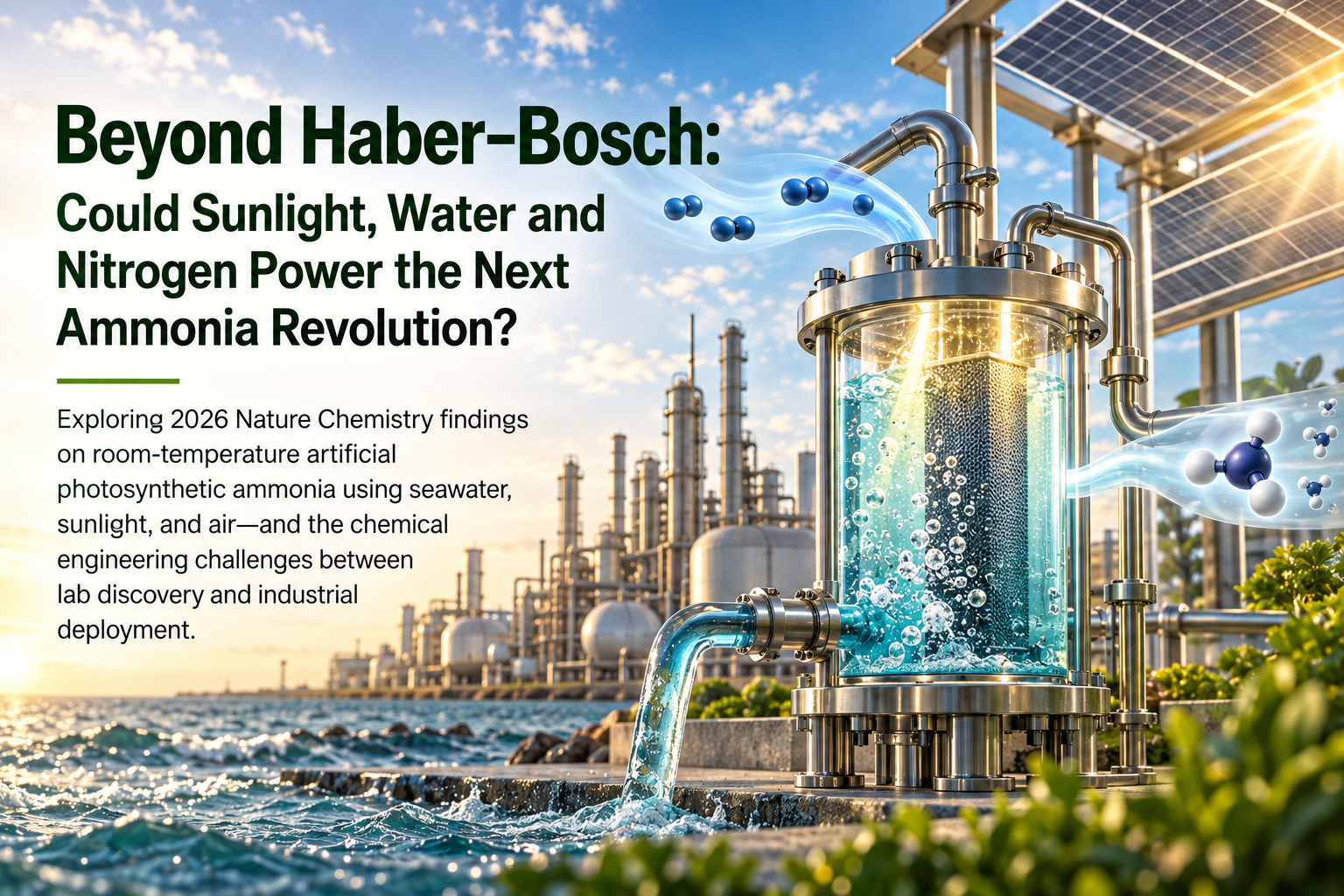
Could the next ammonia revolution come not simply from changing the source of hydrogen, but from fundamentally changing how we activate atmospheric nitrogen?
For more than a century, the Haber–Bosch process has been central to the global nitrogen economy. By combining atmospheric nitrogen with hydrogen at elevated temperature and pressure, it enabled large-scale ammonia production and transformed modern agriculture.
Today, however, ammonia faces a new challenge: how can we produce this essential molecule with substantially lower energy and carbon intensity while maintaining the productivity, reliability and economics demanded by industry and agriculture?
The Nature Chemistry Discovery
In his 17 September 2026 News & Views, Jens Uhlig highlights a pathway in which iron salts and a molybdenum catalyst drive the photosynthetic reduction of atmospheric nitrogen to ammonia, using water as the terminal electron donor.
The discussion accompanies breakthrough research by Zidouhia, Tassaing, Penin, Grau and Bassani, published on 25 August 2026, demonstrating artificial photosynthetic nitrogen reduction to ammonia at room temperature using natural seawater and ambient air.
1. Why Ammonia Matters
Ammonia is far more than a commodity chemical. It is fundamental to fertilizer production and therefore global food systems. It also serves as a vital feedstock for chemicals and is increasingly being considered as a high-density energy carrier and zero-carbon hydrogen vector.
The conventional industrial route, however, remains energy intensive and strongly linked to fossil-derived hydrogen. The emerging green-ammonia model addresses part of this challenge:
This approach can substantially reduce ammonia's carbon intensity when renewable electricity supplies the hydrogen. But artificial photosynthetic nitrogen fixation asks a fundamentally different question:
Rather than producing hydrogen in one process and subsequently combining it with nitrogen, the proposed photochemical architecture attempts to generate the required reducing equivalents from water while activating nitrogen directly.
2. The Chemistry: Light, Water, Iron and Molybdenum
The reported system brings together several foundational components in a single coupled redox architecture:
- Atmospheric Nitrogen: N₂ provides the nitrogen source. The researchers demonstrated catalytic activity not only under pure nitrogen conditions, but also in ambient air.
- Water: Water acts as the terminal electron donor, directly connecting nitrogen reduction with water oxidation.
- Light: The reported system uses ultraviolet-C irradiation to generate solvated electrons through iron photochemistry.
- Iron: Inexpensive Fe²⁺ salts generate solvated electrons upon irradiation. The resulting Fe³⁺ species subsequently participate in the photochemical cycle and return toward Fe²⁺ while oxidizing water.
- Molybdenum: A molybdenum molecular catalyst receives reducing equivalents and facilitates multi-electron dinitrogen reduction.
(with water oxidation helping close the redox cycle)
This is scientifically significant because it couples two exceptionally difficult transformations—nitrogen reduction and water oxidation—within an artificial photosynthetic framework.
3. What Did the Research Demonstrate?
The primary study reported a 5.0% quantum yield for ammonia production in water at normal temperature and pressure. Because nitrogen has limited solubility in aqueous solutions, the researchers used elevated N₂ pressure to increase performance, reaching a reported quantum yield of 10.8%.
Crucially, the researchers also demonstrated the chemistry in unpurified seawater and ambient air, proving that the reaction is not restricted to ultra-pure laboratory feedstocks. The authors calculated a 7.6% light-to-chemical energy conversion efficiency for the investigated photosynthetic process.
"These results are important scientific milestones. However, they should not be interpreted as evidence that a commercial solar-ammonia plant is already ready for deployment. The critical question now changes from: 'Can the chemistry work?' to: 'Can the chemistry become an efficient, durable, safe and economically viable industrial process?'"
4. Laboratory Success ≠ Industrial Ammonia: The 8 Engineering Parameters
The transition from scientific discovery to commercial technology requires much more than a successful reaction. For emerging ammonia pathways, at least eight engineering parameters require rigorous, systematic evaluation:
1. Productivity
Industrial ammonia production operates at enormous scale. A high quantum yield does not automatically mean high ammonia productivity. Systems must establish volumetric productivity, catalyst turnover, areal productivity, and residence time: How many kilograms of NH₃ can the reactor produce per cubic metre per day?
2. Selectivity
Nitrogen reduction competes heavily with parasitic pathways that consume electrons without producing ammonia (especially proton reduction to H₂). Every diverted electron represents wasted photon energy and lower yield. Catalysts must optimize N₂ activation + electron/proton transfer while suppressing competing reactions.
3. Energy Efficiency
The complete energy balance must extend far beyond photon absorption. A commercial assessment must include light generation/solar collection, gas handling, pumping, mixing, catalyst synthesis, ammonia separation, water treatment, compression, and recycling: system-level energy consumption per tonne of NH₃.
4. Catalyst Stability
Catalyst lifetime determines commercial feasibility. Research must establish turnover number (TON), turnover frequency (TOF), long-duration stability, regeneration, metal leaching, photodegradation, and impurity tolerance. Iron is inexpensive and abundant; molybdenum introduces critical questions regarding catalyst durability and lifecycle economics.
5. Nitrogen Mass Transfer
N₂ has notoriously limited solubility in water (approx. 18 mg/L at 25°C). Overcoming gas–liquid mass transfer limitations requires pressurized reactors, advanced sparging, membrane contactors, microstructured reactors, and optimized hydrodynamics. This is where chemical engineering becomes as critical as molecular chemistry.
6. Ammonia Separation
Producing ammonia in an aqueous system is only the first step. The NH₃ must be recovered at commercially useful concentration. If the reaction generates dilute ammonia, downstream separation (membrane distillation, adsorption, stripping, reactive absorption, or electrochemical recovery) could consume substantial energy.
7. Photoreactor Scale-Up
Photochemical scale-up presents a unique challenge: light penetration attenuation (Beer-Lambert law). A larger vessel does not yield proportionally larger output. Engineers must balance photon flux, optical path length, catalyst concentration, and residence time, favouring modular, distributed, and intensified flow photoreactors.
8. Lifecycle Sustainability
A process is not sustainable simply because it uses sunlight and water. A complete LCA must track: Catalyst → reactor → light source → energy input → water → nitrogen → separation → recycling → end-of-life. A decisive future question is whether direct natural solar irradiation can drive the system economically, or whether catalysts can be shifted into visible light.
5. Beyond Haber–Bosch: A Portfolio of Ammonia Technologies
The future ammonia industry will not be defined by a single universal technology. Different pathways will serve distinct scales, regions, and application envelopes:
- Haber–Bosch + Renewable H₂:
Renewable electricity → Electrolysis → H₂ → Haber–Bosch → NH₃. Leverages mature global industrial infrastructure while replacing fossil methane reforming. Ideal for gigawatt-scale coastal hubs. - Electrochemical Nitrogen Reduction (eNRR):
N₂ + H₂O + electricity → NH₃. Offers modular, potentially lower-temperature ammonia production, but requires continuing advances in selectivity, current density, stability, and Faradaic efficiency. - Photochemical / Artificial Photosynthetic Ammonia:
N₂ + H₂O + light → NH₃. Seeks direct solar energy conversion into chemical bonds while coupling nitrogen reduction and water oxidation under ambient conditions. - Biological Nitrogen Fixation: Engineering biological pathways, diazotrophs, and enhancing crop–microbe interactions to complement synthetic fertilizers and curb agricultural runoff.
- Integrated Renewable-Ammonia Systems:
Solar + Wind + Electrolysis + N₂ separation + Ammonia synthesis + Storage + Fertilizer + Precision application. An integrated low-carbon nitrogen ecosystem.
6. The Bigger Question: What Replaces Haber–Bosch?
Perhaps asking "What replaces Haber–Bosch?" is the wrong question entirely. A more useful chemical engineering question is:
Large centralized plants will likely continue relying on highly optimized thermochemical synthesis. Renewable-rich coastal zones will combine GW-scale electrolysis with advanced Haber–Bosch loops. Distributed agricultural applications may eventually favour modular electrochemical or photochemical units. The future is therefore a portfolio of complementary nitrogen technologies.
7. From Green Hydrogen to Green Nitrogen
Today's clean-energy transition focuses heavily on replacing fossil hydrogen with green hydrogen:
That transition remains strategically essential. But artificial photosynthetic nitrogen fixation introduces another dimension, evolving the innovation frontier from:
The significance of the 2026 Nature Chemistry study is therefore not that Haber–Bosch has suddenly become obsolete. Rather, it expands the fundamental technological landscape for sustainable ammonia.
8. Why Agriculture Must Remain Part of the Conversation
Ammonia production is only one half of the nitrogen challenge. For agricultural applications, the ultimate objective is not simply to manufacture NH₃, but to deliver nitrogen to crops efficiently while minimizing environmental losses:
Therefore, sustainable ammonia must be integrated with precision nutrient management, variable-rate fertigation, improved slow-release formulations, real-time soil monitoring, and rigorous environmental MRV (Measurement, Reporting & Verification). A lower-carbon ammonia molecule does not automatically create a sustainable agricultural system; production and utilization must be optimized together.
9. SSDE Perspective: From Molecular Innovation to Market Impact
At Sustainable System Design Enterprises (SSDE), Gurugram, we view emerging ammonia transitions through an integrated systems-engineering lens:
Energy Loop: Renewable Energy → H₂ / Photochemistry → NH₃ → Energy Storage / Fuel / Chemicals
The core challenge is determining where each pathway delivers measurable value across nine critical dimensions:
Productivity • Energy • Carbon • CAPEX • OPEX • Safety • Reliability • Scalability • Lifecycle Impact
10. From Lab → Pilot → Plant → Market
The most important lesson from emerging ammonia research is that scientific discovery is only the starting point. The technology-development pathway must progress systematically through established stage gates:
Proof of Concept ↓
Technology Validation ↓
Process Design ↓
Pilot Demonstration ↓
Techno-Economic & Lifecycle Assessment ↓
Commercial Demonstration ↓
Market Deployment & Real-World Impact
Concluding Remarks: Could Sunlight Redefine Ammonia?
The idea of converting atmospheric nitrogen and water into ammonia using light captures an ambitious vision for sustainable chemistry. The recent Nature Chemistry research demonstrates an artificial photosynthetic pathway in which iron photochemistry, molybdenum catalysis, nitrogen reduction, and water oxidation work together under ambient conditions.
The next ammonia revolution may not be about replacing Haber–Bosch overnight; it is about expanding the technological toolbox beyond it. The strategic question is no longer simply: "How do we make green ammonia?" It is: "How do we design a sustainable nitrogen ecosystem from air to ammonia to agriculture and energy?"
Scientific References
- Uhlig, J. (2026). Forging ammonia with iron and light from water and nitrogen. Nature Chemistry, 17 September 2026. DOI: 10.1038/s41557-026-02253-z.
- Zidouhia, D., Tassaing, T., Penin, N., Grau, É. & Bassani, D. M. (2026). Artificial photosynthetic reduction of nitrogen to ammonia at room temperature using natural seawater. Nature Chemistry, 25 August 2026. DOI: 10.1038/s41557-026-02218-2.
Engage with Dr. Deepak Yadav's technical analysis and systems perspective.