
Before blueprints, CAD software, digital twins, AI-assisted design and automated manufacturing, human beings were already asking fundamental engineering questions:
- What material should I use?
- How should I shape it?
- How will it function?
- How can I make it stronger, safer and more durable?
- How can an idea become reality?
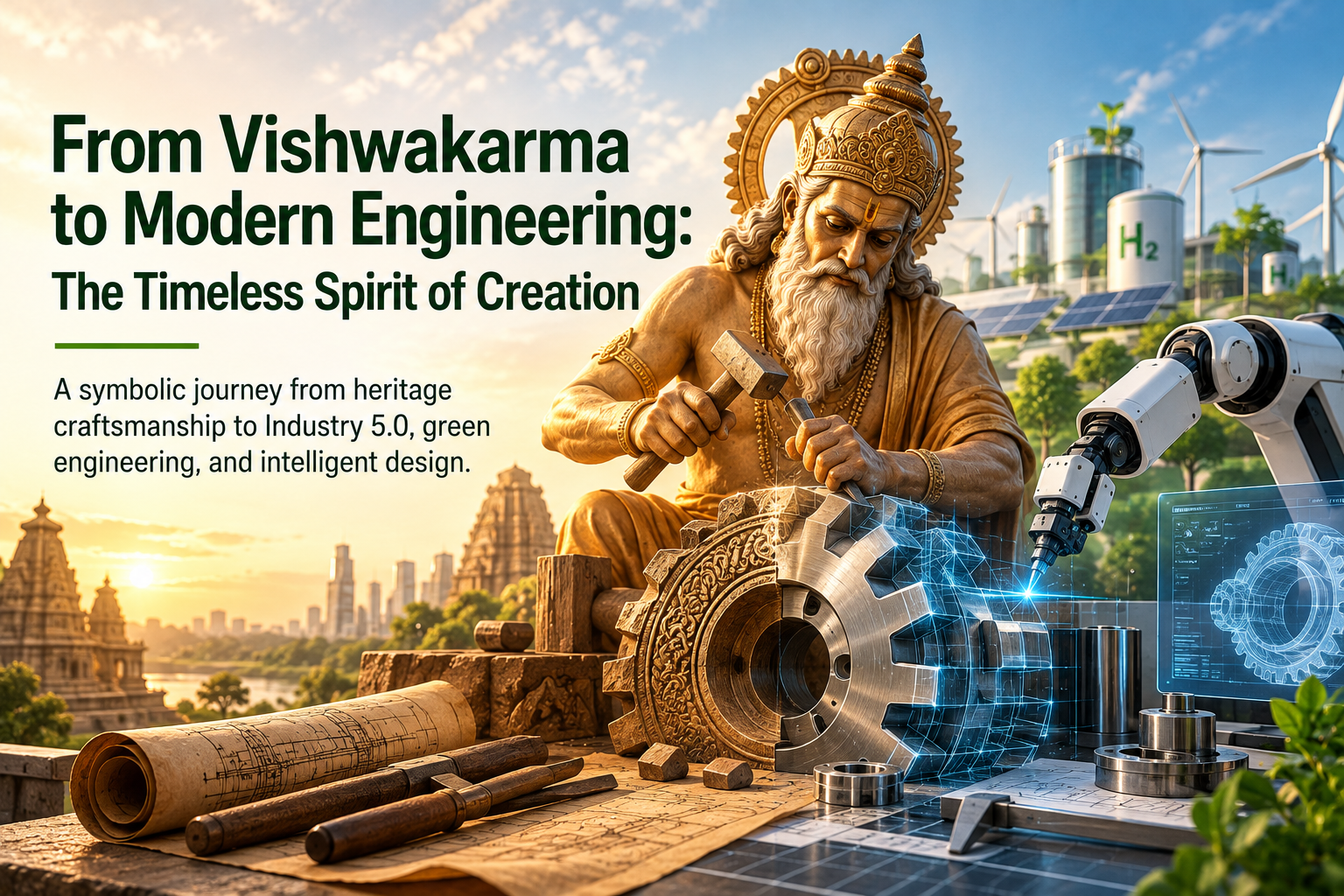
In Indian cultural tradition, Lord Vishwakarma is revered as the divine architect, craftsman and creator—a powerful symbol of the human capacity to transform imagination into physical reality.
Rather than trying to reinterpret ancient mythology as evidence of technologies that did not historically exist, there is another, more productive way to approach Vishwakarma: as a cultural metaphor for the engineering mindset itself. For modern engineers, innovators and technology leaders, this perspective offers several enduring lessons.
01 | MATERIALS → ENGINEERED POSSIBILITY
Every engineering solution begins with a fundamental question: What can this material do?
Traditional Indian craftsmanship developed sophisticated relationships with materials including Wood, Stone, Copper, Bronze, Iron, and Precious Metals. Across generations, artisans developed specialized knowledge of:
- Material behaviour and internal structure
- Tools, tooling, and precision shaping
- Joining, forming, and casting techniques
- Surface treatments and corrosion barriers
- Structural load requirements and stability
- Aesthetic and functional design integration
This is an essential principle for contemporary engineering as well. Whether we are working with advanced alloys, heterogeneous catalysts, polymers, composites, semiconductors or nanomaterials, innovation begins by understanding the foundational relationship:
Design thinking therefore begins with material intelligence.
02 | IMAGINATION → FUNCTIONAL CONCEPT
Engineering does not begin with a machine. It begins with a problem, need or vision.
Indian epics contain extraordinary descriptions of objects and vehicles, including the Pushpaka Vimana and Sudarshana Chakra. These belong to the realm of mythology and epic literature rather than documented technological history. Yet they remain interesting from a design-thinking perspective because they represent imaginative attempts to conceptualize capabilities such as:
- Advanced aerial mobility and autonomous navigation
- Precision action and localized force transfer
- Directional tracking, feedback, and control
- Human–machine interaction and functional responsiveness
"The important question is not: ‘Did ancient technology actually exist?’ A more useful engineering question is: ‘What human need or capability was the story trying to imagine?’ That distinction allows us to appreciate cultural imagination without confusing mythology with historical engineering evidence."
03 | HERITAGE → ENGINEERING THAT ENDURES
India’s engineering heritage does not require speculative explanations to be remarkable. There are tangible achievements that continue to attract rigorous scientific and engineering interest:
The Delhi Iron Pillar: The Iron Pillar near the Qutb complex is widely studied for its remarkable atmospheric corrosion resistance over 1,600 years. Its behaviour has been associated with characteristics of the wrought-iron material and its processing, including relatively high phosphorus content and the formation of a protective crystalline iron hydrogen phosphate hydrate passive film (misawite) on the surface.
The broader lesson is significant: Durability is engineered. Material composition, processing history, environmental exposure, and surface chemistry interact dynamically to determine long-term performance.
Kailasa Temple, Ellora: The Kailasa Temple at Ellora represents an extraordinary feat of rock-cut architecture and subtractive construction. Rather than assembling a structure from separately manufactured blocks, the entire multi-story monument was carved downwards from a single solid basalt cliff face (removing over 200,000 tonnes of rock).
The engineering comparison is conceptually fascinating: In additive manufacturing, you build by adding material. In subtractive manufacturing, you create by systematically removing it. The same principle governs modern precision CNC machining, semiconductor lithography, and advanced fabrication today. The tools have changed, but the fundamental engineering challenge has not: Control the process. Manage uncertainty. Minimise error. Achieve the intended form.
04 | CRAFT → SCIENCE → ENGINEERING → INTELLIGENCE
The history of engineering can be viewed as an evolving continuum:
This is not a replacement of one era by another; it is an accumulation of capabilities. Today’s engineer inherits centuries of human learning and augments it with cutting-edge tools:
CAD + CAE + AI + Robotics + Digital Twins + Advanced Materials + Data Analytics + Automation
Yet technology alone does not create meaningful innovation. The human ability to define the right problem remains fundamental.
05 | DESIGN THINKING → SOLVING THE RIGHT PROBLEM
One of the strongest lessons from the engineering tradition is that good design is purposeful. A successful design must balance:
- Functionality & Performance
- Materials compatibility & availability
- Manufacturability & assembly
- Operational safety & process hazards
- Long-term reliability & maintenance
- Capital and operating economics
- User and community needs
- Environmental footprint & lifecycle performance
This is where engineering meets design thinking. A modern engineer should ask: “What problem are we actually solving?” Not: “What technology can we deploy?” but: “What outcome does the user, industry, or society need?” That shift—from technology-first thinking to problem-first thinking—can fundamentally elevate innovation outcomes.
06 | INDUSTRY 5.0 → HUMAN + MACHINE + PLANET
Industry 5.0 extends the conversation beyond sheer automation and productivity. Its emerging framework places greater emphasis on:
- Human-centricity: Prioritizing human well-being, ergonomics, and worker empowerment.
- Intelligent Automation: AI, robotics, and cyber-physical systems working as partners.
- Sustainability & Circularity: Designing zero-waste loops and high resource efficiency.
- Clean Energy Transition: Decarbonized grids, renewable electrification, and low carbon fuels.
- Resilience: Systems capable of absorbing geopolitical, climatic, and supply shocks.
- Human–Machine Collaboration: Augmenting human creativity and judgement with computational power.
07 | FROM VISHWAKARMA TO GREEN ENGINEERING
The Vishwakarma metaphor becomes especially urgent when we look at today’s sustainability challenges. Consider the integrated systems required for:
Green Hydrogen:
Renewable electricity → Water treatment → Electrolysis → Hydrogen conditioning → Compression/storage → End-use integration
Green Ammonia:
Renewable energy → Green hydrogen → Nitrogen generation → H₂/N₂ conditioning → Ammonia synthesis → Purification → Storage & handling → Carbon-intensity management
Circular Economy:
Waste streams → Resource recovery → Process engineering → Materials transformation → High-value products → Industrial reintegration
These are not isolated technologies; they are integrated engineering ecosystems requiring systems thinking, materials understanding, process kinetics, safety, integration, and continuous optimization.
08 | THE NEW ENGINEER: SYSTEMS THINKER
The engineer of the future must look far beyond individual unit operations:
This demands five key transitions:
- From component thinking → systems thinking
- From narrow efficiency → systemic resilience
- From linear extraction → circular loops
- From isolated automation → human–machine collaboration
- From technology deployment → outcome-oriented innovation
09 | THE TIMELESS ENGINEERING PRINCIPLE
The story of Vishwakarma reminds us of something simple but profound:
Creation begins in the imagination. Engineering gives that imagination structure. Science provides understanding. Materials provide possibility. Manufacturing provides physical reality. Digital technologies provide intelligence. And sustainability provides responsibility toward the future.
Conclusion: Engineering Is a Human Endeavour
From traditional artisan workshops to modern laboratories, from stone monuments to advanced nanomaterials, and from mechanical levers to AI-enabled industrial ecosystems, engineering represents a continuous human effort to transform knowledge into useful reality.
Lord Vishwakarma, viewed through the lens of cultural tradition, offers a powerful symbol of that journey. Today, that responsibility extends further: we are no longer designing only machines and structures; we are designing energy systems, circular economies, intelligent factories, sustainable agriculture, and resilient industrial ecosystems.
The next generation of engineering will require more than technical expertise—it will require curiosity, systems thinking, material intelligence, human creativity, digital capability, and the courage to imagine better possibilities. From Vishwakarma to Industry 5.0, the tools have changed—but the spirit of creation remains.