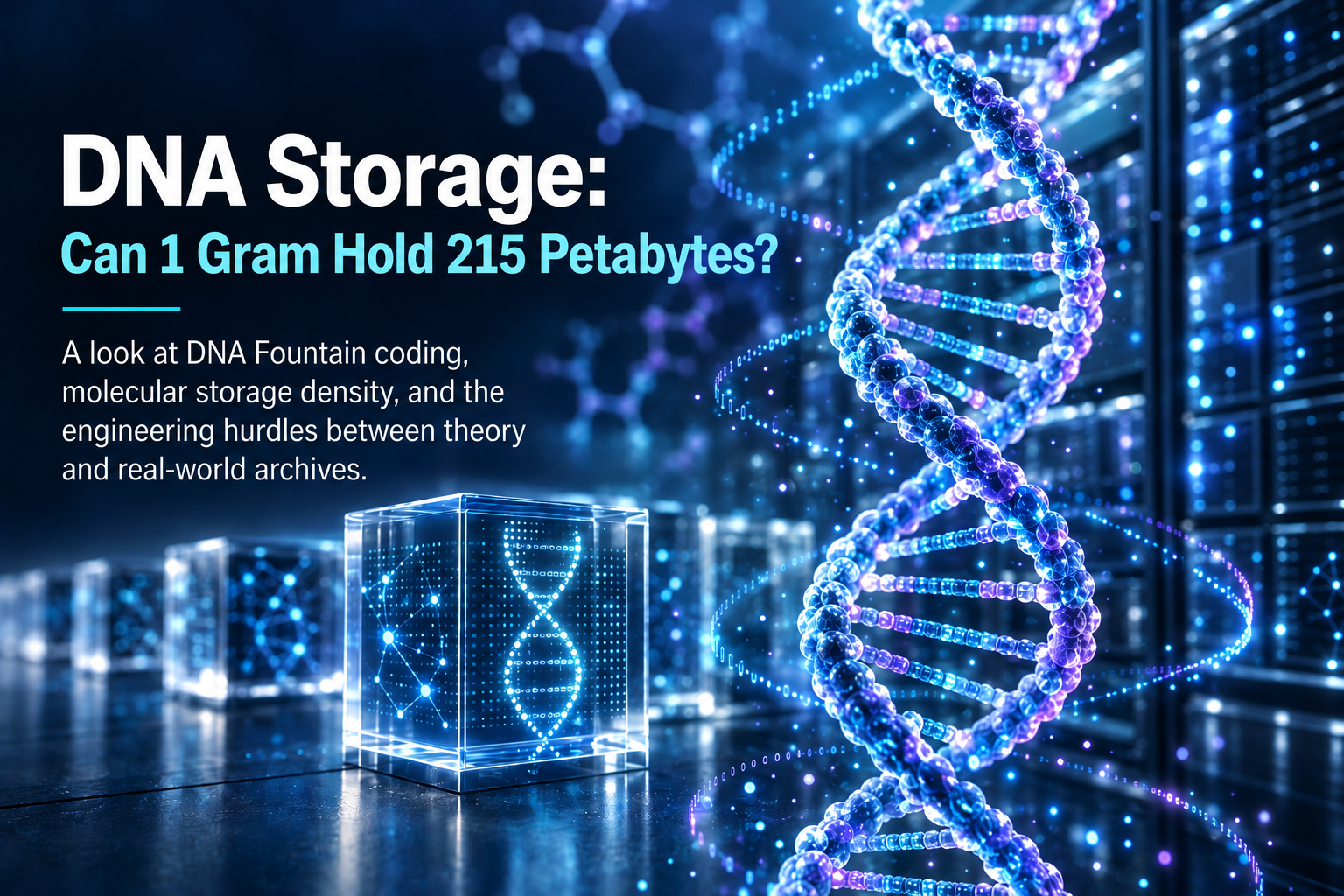
What if the next generation of data storage is not a silicon microchip or a magnetic platter—but a biological polymer?
As global data volumes accelerate past 175 zettabytes, conventional storage technologies are hitting physical, geographic, and energetic limits. Data centers consume immense power for cooling and power supply, and magnetic tape degrades within decades. Among the radical alternatives being explored worldwide, DNA data storage stands out as arguably the most profound: encoding binary information directly into the four chemical bases of synthetic DNA: Adenine (A), Cytosine (C), Guanine (G), and Thymine (T).
The 215 Petabytes per Gram Breakthrough
A landmark 2017 study published in Science by Yaniv Erlich and Dina Zielinski introduced DNA Fountain, a coding architecture adapted from streaming network fountain codes. DNA Fountain was designed to package digital information into short oligonucleotide fragments while maximizing packaging efficiency and resilience against dropouts.
The researchers reported an extraordinary extrapolated information density:
That is approximately 215 million gigabytes per gram. At this molecular density:
- 1 gram ≈ 215 Petabytes (PB)
- 10 grams ≈ 2.15 Exabytes (EB)
- 50 grams ≈ 10.75 Exabytes (EB)
- 1 kilogram ≈ 215 Exabytes (enough to store a vast fraction of humanity's digital records)
"⚠️ An Important Scientific Distinction: The 215 PB/g figure is an extrapolated molecular-scale density calculation. It does not mean researchers synthesized a physical 1-gram sample containing 215 PB of user data. In the actual 2017 experiment, approximately 2.14 MB of digital files (including an operating system, a film, and an Amazon gift card) were synthesized into DNA oligos and 100% error-free reconstructed upon high-throughput sequencing."
How Does DNA Data Storage Work?
A functional molecular storage pipeline follows an end-to-end information architecture:
While DNA's 4-base alphabet provides a theoretical ceiling of 2 bits per nucleotide, practical systems must carefully balance biochemical constraints:
- GC-Content Balancing: Avoiding extreme G-C or A-T concentrations that cause secondary hairpin folding or synthesis dropouts.
- Homopolymer Avoidance: Preventing repetitive runs (e.g., AAAAA) that cause base-calling shifts during sequencing.
- Error-Correction Codes: Employing Reed-Solomon and Luby Transform (fountain) codes to survive molecule degradation and missing fragments.
- Indexing & Random Access: PCR primer-binding handles allowing targeted retrieval of specific files without sequencing the entire pool.
Why DNA Storage Matters for Chemical & Systems Engineering
DNA storage is not intended to replace ultra-fast NVMe SSDs or RAM in consumer laptops. Its true potential lies in deep, cold archival storage:
- Astronomical Density: Orders of magnitude denser than any magnetic or optical medium known to physics.
- Millennia-Scale Longevity: Under dry, cool conditions (such as embedded in silica or frozen), DNA remains legible for centuries without power input—proven by ancient DNA recovered from mammoths over 1 million years old.
- Universal Reading Guarantee: As long as human civilization studies molecular biology and medicine, sequencers will exist to read DNA. Unlike obsolete 8-track tapes or floppy disks, DNA will never face machine obsolescence.
The Real-World Bottlenecks: Storage Density ≠ Practicality
Despite the headline density numbers, several critical chemical engineering hurdles must be overcome before commercial deployment:
- Synthesis Cost: Chemical phosphoramidite synthesis remains expensive (hundreds to thousands of dollars per megabyte). Enzymatic DNA synthesis (TdT) is advancing rapidly to lower costs.
- Writing Throughput: Synthesizing billions of base pairs per second requires microfluidic and electrochemical array scaling.
- Retrieval Latency: PCR amplification and sequencing require hours to days, restricting use cases to static archival data.
- Automation: Integrating wet-lab pipetting into dry, rack-mounted server appliances without human handling.
The Bigger Picture: From Bits to Bases
DNA storage asks a transformative question: Can information itself become a stable chemical molecule?
This challenge connects biotechnology, computer science, materials science, automation, and chemical engineering. The future of data infrastructure may soon feature a hybrid molecular tier—preserving humanity’s most vital scientific, cultural, and historical records inside microscopic drops of synthetic DNA.
Primary Reference:
Erlich, Y. & Zielinski, D. (2017). DNA Fountain enables a robust and efficient storage architecture. Science, 355(6328), 950–954. DOI: 10.1126/science.aaj2038.