
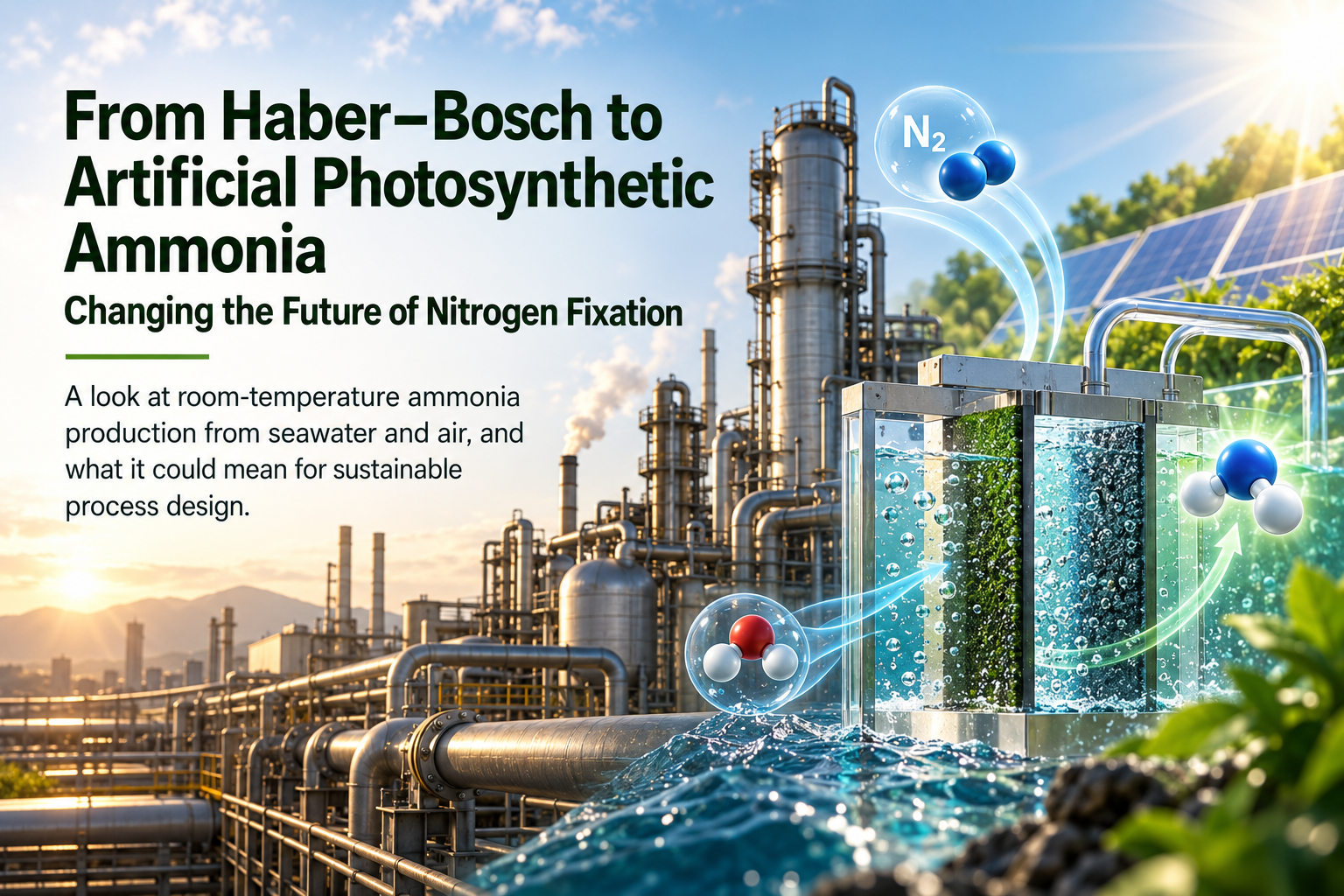
Is the next ammonia revolution about decarbonizing the hydrogen feedstock—or eliminating the conventional molecular H₂ pathway altogether?
For more than a century, the Haber–Bosch process has been the undisputed bedrock of global industrial chemistry and agricultural survival. Synthesizing ammonia from atmospheric nitrogen and hydrogen follows a simple stoichiometric equation: N₂ + 3H₂ → 2NH₃. Yet achieving this transformation at commercial scale demands an immense chemical plant infrastructure: cryogenic nitrogen purification, hydrogen generation via fossil steam methane reforming (SMR) or water electrolysis, high-pressure compressors (150–250 bar), catalytic converters operating at 400–500°C, complex heat exchanger networks, and multi-stage refrigeration recycle loops.
Today’s conventional green ammonia transition predominantly maintains this century-old synthesis core while substituting fossil gas with green hydrogen:
While vital, this route incurs substantial cumulative energy penalties across conversion steps, hydrogen compression, and thermal swings. But what if the intermediate hydrogen generation step could be bypassed? What if dinitrogen could be reduced directly to ammonia using water as the proton/electron source and sunlight as the driving energy input?
That provocative question is the focus of a milestone study published in Nature Chemistry by Doha Zidouhia, Thierry Tassaing, Nicolas Penin, Étienne Grau, and Dario M. Bassani. The authors demonstrated light-driven ammonia synthesis from N₂ and water at ambient room temperature and pressure, including remarkable runs in unpurified natural seawater and ambient air.
1. Why Ammonia Is Strategically Essential
Ammonia is far more than an industrial commodity. It directly supports synthetic nitrogen fertilizers, crop nutrition, food security for over 4 billion people, refrigeration, explosives, and pharmaceutical intermediates. Furthermore, in the net-zero transition, ammonia is rapidly emerging as a preferred hydrogen and energy carrier: unlike gaseous H₂, ammonia liquefies at a mild -33°C (or moderate pressure), has an established global shipping and terminal network, and carries higher volumetric energy density than liquid hydrogen.
2. The Century-Old Haber–Bosch Benchmark
The stability of the dinitrogen molecule is formidable: its covalent triple bond (N≡N) possesses an enormous dissociation energy of 945 kJ/mol. Over 110 years of optimization, Haber–Bosch plants have achieved remarkable thermal and chemical efficiency (>70% LHV basis). Consequently, any emerging technological contender is competing not with an inefficient prototype, but with the pinnacle of mature global chemical engineering.
3. Three Emerging Architectures for Low-Carbon Ammonia
The future ammonia landscape will likely feature a diversified portfolio of chemical architectures:
- Route A — Green Hydrogen + Haber–Bosch: Mature, centralized, capital-intensive. Ideal for gigawatt-scale coastal hydrogen hubs.
- Route B — Electrochemical Nitrogen Reduction (eNRR): Uses renewable electricity to drive aqueous or non-aqueous electrochemical reduction. Faces persistent challenges in Faradaic efficiency, severe competition from the Hydrogen Evolution Reaction (HER), and low partial current densities.
- Route C — Artificial Photosynthetic Ammonia: Photons drive direct charge transfer:
Sunlight + Water + Dinitrogen → Ammonia + Oxygen. Mimics biological nitrogenase enzymes by coupling water oxidation directly to nitrogen reduction under mild conditions.
4. The Nature Chemistry Breakthrough: Photochemical Redox Cycling
The 2026 system reported by Zidouhia and colleagues utilizes an earth-abundant iron(II) salt coupled with a molecular molybdenum catalyst. Under UVC excitation, the iron species generates solvated electrons that reduce the active molybdenum complex, which in turn coordinates and activates N₂. The resulting oxidized Fe(III) species then participates in water oxidation, regenerating Fe(II) and closing the photochemical catalytic cycle.
"The conceptual leap is profound: the system does not simply illuminate a catalyst in the presence of sacrificial donors. It establishes a complete, coupled redox cycle where water provides the reducing equivalents, nitrogen is reduced to ammonia, and iron is cyclically regenerated."
5. Techno-Economic Evaluation Matrix
To assess where each technological pathway stands from an industrial perspective, Sustainable System Design Enterprises (SSDE) has synthesized a comparative framework:
| Evaluation Parameter | Green H₂ + Haber–Bosch | Electrochemical N₂ Reduction | Artificial Photosynthetic NH₃ |
|---|---|---|---|
| Primary Energy Feed | Renewable electricity | Renewable electricity | Solar photons / light |
| Molecular H₂ Generation | Mandatory (Electrolyser) | Not directly required | Bypassed completely |
| Operating Temperature | High (400 – 500°C) | Low to Moderate (25 – 80°C) | Ambient (20 – 25°C) |
| Operating Pressure | 150 – 250 bar | 1 – 30 bar | 1 – 10 bar |
| Activation Mechanism | Heterogeneous thermo-catalysis | Electrocatalysis | Photochemical redox |
| Water Feedstock Role | Electrolyser feed | Electrolyte / reactant | Electron & proton source |
| Key Engineering Hurdle | H₂ storage & thermal cycling | Low Faradaic efficiency & HER | Photon flux, UVC vs solar, rates |
| Technology Readiness (TRL) | TRL 7 – 9 (Commercial) | TRL 3 – 4 (Lab bench) | TRL 2 – 3 (Early scientific) |
| Primary Scaling Metric | Levelized Cost (₹/kg NH₃) | Current density (mA/cm²) | Areal yield (g NH₃/m²·day) |
6. The Critical Chemical Engineering Scale-Up Hurdles
While the scientific milestone is unquestioned, translating aqueous photochemistry into an industrial-scale manufacturing plant introduces major chemical engineering challenges:
- The Solar Spectrum vs. UVC Spectrum: The reported system operates under ultraviolet-C light (wavelengths <280 nm), which represents virtually 0% of the terrestrial solar spectrum. For commercial viability, catalyst systems must be sensitized to absorb in the visible solar spectrum (400–700 nm). If artificial UVC lamps are required, the electricity parasitic load negates the direct-solar advantage.
- Aqueous Nitrogen Mass Transfer: Dinitrogen exhibits notoriously low solubility in water (approx. 18 mg/L at 25°C). Overcoming gas-liquid mass transfer limitations requires pressurized bubble columns, microfluidic contacting, or gas-diffusion membranes.
- Dilute Product Separation: Unlike Haber–Bosch plants where pure anhydrous liquid ammonia is condensed by chilling, aqueous photochemical systems generate dilute ammonium solutions (ppm to low millimolar). Stripping, membrane distillation, or ion-exchange recovery can consume more energy than the synthesis itself if unoptimized.
- Seawater Impurity Management: While the study demonstrated robustness in natural seawater, long-term continuous operation must mitigate biofouling, calcium/magnesium scaling, and chlorine evolution side reactions.
7. SSDE's Systems Perspective: Multidisciplinary Engineering
At Sustainable System Design Enterprises (SSDE), Gurugram, our chemical engineering consultancy views emerging energy transitions through an integrated systems lens:
The question for industrial developers is never simply: "Does this reaction work in a beaker?" The decisive question is: "Can this reaction be scaled into an environmentally, economically, and operationally resilient production facility?"
8. Strategic Implications for India
India possesses world-class solar irradiance (over 300 sunny days/year in western regions), the world's second-largest agricultural fertilizer market, and a proactive National Green Hydrogen Mission. Evaluating multiple ammonia production architectures simultaneously—centralized green hydrogen plants for heavy industry alongside modular or distributed solar-assisted systems for local fertilizer needs—positions Indian industry at the frontier of global clean chemical innovation.
Primary Scientific Reference:
Zidouhia, D., Tassaing, T., Penin, N., Grau, É., & Bassani, D. M. (2026). Artificial photosynthetic reduction of nitrogen to ammonia at room temperature using natural seawater. Nature Chemistry. Published online 25 August 2026. DOI: 10.1038/s41557-026-02218-2.